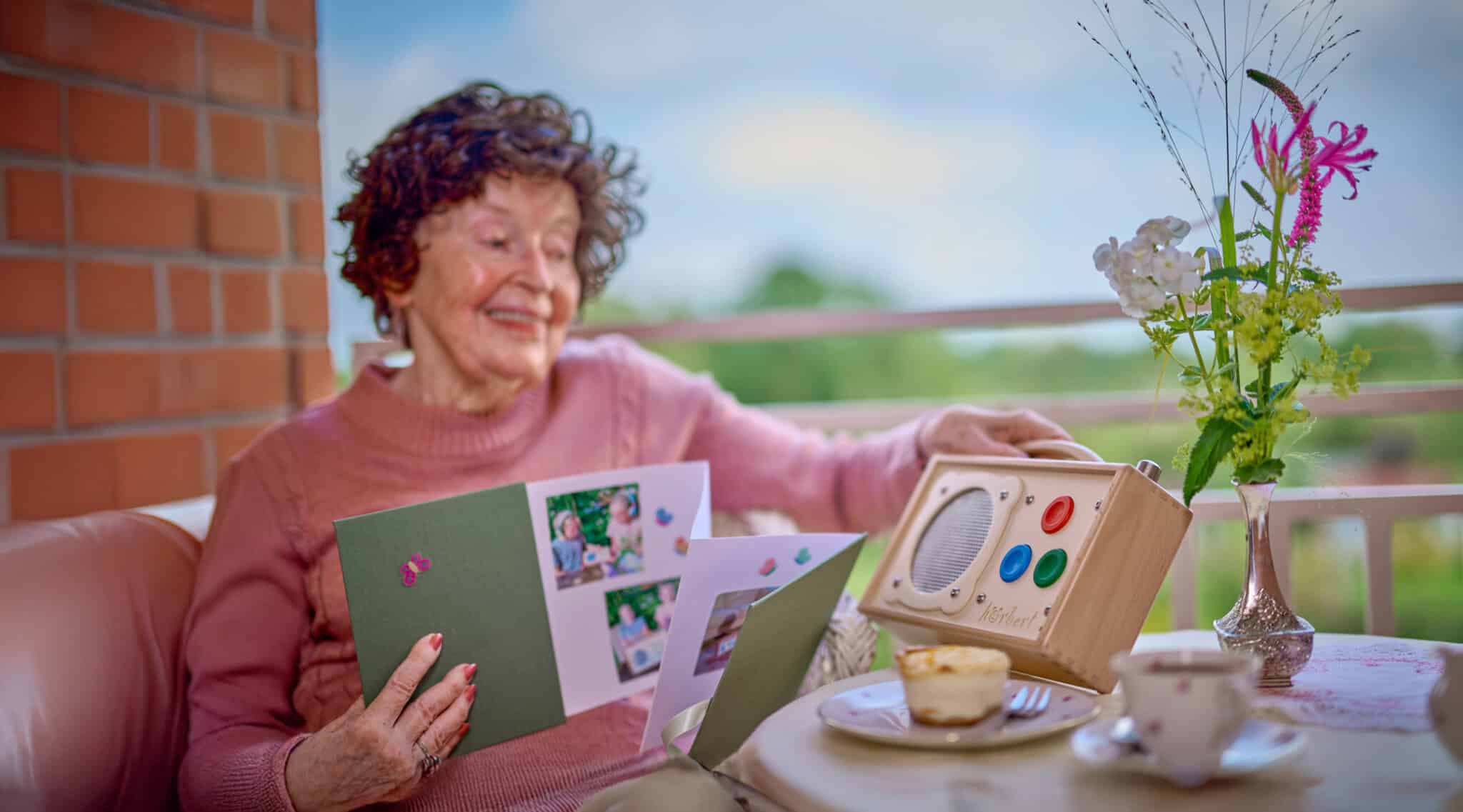
The use of music in the treatment of dementia patients has become increasingly important in recent years. Individualised music interventions in particular, in which personal favourite songs are used, show promising results in improving the well-being and quality of life of people with dementia. (3/2022 aktivieren.net – Lieblingsmusik im Blick der Wissenschaft)
Music has the unique ability to activate memories that are deeply rooted in memory. Studies show that certain regions of the brain responsible for processing music remain relatively unaffected, even in the advanced stages of dementia. This allows familiar melodies to evoke emotional responses and stimulate long-term memory.(fsv.uni-jena.de)
The key to success lies in the selection of pieces of music that have a personal meaning for the patient. These songs, often from adolescence or early adulthood, are closely linked to positive memories and emotions. Listening to this music can not only increase emotional well-being, but also reduce agitated behaviour and promote social interaction.(fsv.uni-jena.de)
The effectiveness of individualised music therapy depends crucially on the right choice of music. The aim is to identify pieces of music that have had a personal, emotional significance in the life of the person concerned – usually from the period between the ages of 15 and 30. During this phase, music is experienced particularly intensively and stored emotionally, which makes it easier to recall later in life.
Helpful steps for compiling playlists::
The selection should be regularly reviewed and adjusted, as emotional approaches also change as dementia progresses. A good playlist is never final – it lives with the person.
Carers and relatives report positive changes in patients’ behaviour and mood during and after listening to music. The atmosphere in the homes and families was positively influenced and the mood was brightened with positive energy. Patients who were previously often verbally unruly were more sociable and it was possible to reintegrate them into the shared living area. In general, there was more contact between the dementia patients themselves or with relatives and staff (fsv.uni-jena.de, opendata.uni-halle.de)
One example of successful implementation is the ‘Individualised music for people with dementia’ project at Friedrich Schiller University Jena, in which regular listening to personally meaningful music led to an improvement in quality of life and a reduction in problematic behaviour.
Modern technologies can facilitate the use of music therapy. One example is the ‘hörbert’, a portable music player, the accessible version of which was developed especially for senior citizens and carers. With its simple operation without complicated menus or displays, it enables dementia patients to listen to their favourite music independently at the touch of a button up to a certain degree of dementia.
Songs and stories can be organised into three or nine playlists. Behind each of hörbert’s colourful playlist buttons is a whole series of tracks which – if there is no interaction – are all played one after the other. By repeatedly pressing the same playlist button, you can also actively move forward one track in a playlist. Even if it is only possible to press a large, external control button repeatedly, the barrier-free hörbert with a socket connection for external buttons can still be operated and music played. This not only promotes independence, but also the self-esteem of those affected and relieves the burden on carers.
Individualised music therapy stands and falls with easy access to the right songs – and this is precisely where hörbert shows its particular strength. Thanks to sophisticated technology, the personal music library can be transferred to the device in various ways, without any technical hurdles. This means that relatives or carers can flexibly and easily ensure that favourite songs are always to hand.
Favourite songs that have already been identified can be transferred directly from music services such as Spotify, Audible, YouTube or other streaming platforms to hörbert. To do this, simply pair a smartphone or tablet with the device via Bluetooth and play the music. At the same time, hörbert can record these tracks onto the memory card using its integrated recording function – a particularly easy way to make music permanently available without special software or apps. hörbert can also be used as a playback device for Internet radio stations if a 2.4 GHz WLAN is available. hörbert can also record this source.
If you already have a collection of MP3 files or have digitised music from CDs, you can transfer these files to the hörbert memory card in the classic way using copy & paste. The card contains clearly structured folders for the various playlists – the desired tracks simply have to be copied into the appropriate folder. All you need is a computer with an internal or external SD card reader.
If no computer is available, transmission via WLAN is also possible. The user-friendly web interface, known as Browser Set Mode, makes it easy to configure hörbert using a smartphone or tablet and add new tracks directly. At the same time, all other settings for the device can be made here – very intuitively and without special software.
Individualised music therapy offers a promising, non-pharmacological way to positively influence the lives of people with dementia. Whether tech-savvy or not, hörbert makes it easy to put together personalised music playlists and transfer them to the device. This means that nothing stands in the way of effective music therapy at home or in a care facility.
https://opendata.uni-halle.de – Madeleine Helbig – Lieder im Kopf (2020) PDF Download
aktivieren.net – Artikel „Lieblingsmusik im Blick der Wissenschaft“ zur Studie der Friedrich-Schiller-Universität Jena (03/2022)
Friedrich-Schiller-Universität Jena – Studie „Individualisierte Musik für Menschen mit Demenz“ (2020)
GKV Spitzenverband
You are currently viewing a placeholder content from Accessibility Widget. To access the actual content, click the button below. Please note that doing so will share data with third-party providers.
More InformationYou are currently viewing a placeholder content from Vimeo. To access the actual content, click the button below. Please note that doing so will share data with third-party providers.
More InformationYou are currently viewing a placeholder content from YouTube. To access the actual content, click the button below. Please note that doing so will share data with third-party providers.
More InformationYou need to load content from reCAPTCHA to submit the form. Please note that doing so will share data with third-party providers.
More InformationYou are currently viewing a placeholder content from Google Maps. To access the actual content, click the button below. Please note that doing so will share data with third-party providers.
More InformationYou need to load content from reCAPTCHA to submit the form. Please note that doing so will share data with third-party providers.
More Information